
What Is a Pay-by-Link Service Provider?
Payment by link providers are companies that enable e-commerce and brick-and-mortar business owners to offer this digital payment method in their stores. Payment by link is becoming a standard payment method for European businesses that sell outside a traditional online checkout.
Sales conversations now happen by phone, e-mail, and messaging apps. Invoices are sent digitally, and customers expect to pay immediately. Pay by link meets this expectation by turning a payment request into a secure, clickable link.
For business owners in Europe, selecting the right pay-by-link service provider is a strategic decision. Regulation, security, payment acceptance, and settlement reliability all affect revenue and customer trust. The first step to getting started is to learn what pay by link is, how it works, its benefits, and how to choose the right provider.
What Is Pay by Link?
Payment by link is a digital payment method where a business generates a secure checkout link and sends it directly to a customer to collect payment online through a global payment gateway.
Instead of directing customers to a website or physical terminal, the merchant shares a single URL. That link opens a hosted payment page managed by the payment service provider. Customers complete the transaction using cards or supported local payment methods without creating an account or navigating multiple pages.
Pay by link is widely used across Europe for invoicing, professional services, travel bookings, healthcare services, and business-to-business (B2B) transactions where pricing follows a conversation rather than a shopping cart.
How Does Pay by Link Work?
Payment by link works by connecting a payment request to a secure, hosted checkout page that handles processing and authentication.
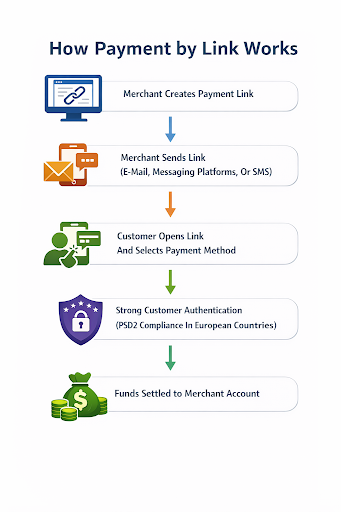
The pay-by-link process follows a clear sequence:
- The merchant creates a payment link inside the payment gateway dashboard. The link includes the amount, currency, and transaction details.
- The merchant sends the link by e-mail, messaging platforms, or SMS (one type of payment by text).
- The customer opens the link and selects a payment method.
- Strong customer authentication must be applied in European countries that are required to comply with PSD2.
- Funds are settled to the merchant account based on the provider’s payout schedule.
Benefits of Using a Pay-by-Link Service Provider
Payment by link offers clear advantages for businesses that operate remotely or rely on invoicing.
Faster Payments and Improved Cash Flow
Payment by link shortens the gap between agreement and payment. Links are sent immediately after a quote or sales call, customers complete payment in a single session, and follow-ups become simpler and more consistent. Faster payments support a healthier cash flow, particularly for service-based and B2B businesses.
Built for Remote and B2B Sales
Payment by link suits business models where products or services are not selected from a catalogue.
This includes:
- Consulting and professional services
- Medical and wellness providers
- Travel agencies and tour operators
- Wholesale and trade suppliers
Reduced Technical Complexity
Payment by link lowers technical overhead because it doesn’t require custom checkout development, doesn’t depend on website uptime, and aligns easily with invoicing and CRM systems. This allows teams to focus on selling and serving customers instead of managing payment infrastructure.
Strong Security and Compliance
Payment by link operates within the same security framework as other online payments, including:
- PCI DSS compliance
- PSD2 and strong customer authentication
- Encrypted, provider-hosted payment pages
Consistent security features across payment methods build customer confidence and reduce payment friction.
How to Choose the Right Pay by Link Provider in Europe
Choosing a pay-by-link service provider involves evaluating the full payment ecosystem, not just the link feature.
European Regulatory Compliance
Payment by link providers must meet strict European standards, including PSD2 compliance, strong customer authentication support, and GDPR-aligned data protection.
Payment Method and Currency Coverage
Payment links should match customer payment preferences.
Make sure the provider supports:
- Major card networks
- Local European payment methods
- Multi-currency pricing and settlement
Customisation and Integration Options
Payment by link should fit into your existing workflows. Branded payment pages, flexible amounts and descriptions, and API access for billing, CRM, or ERP systems lead to a smoother experience for customers and employees.
Settlement, Reporting, and Transparency
Reliable payouts and clear reporting are essential. Ask about settlement speed, fee transparency, and transaction and reconciliation reports when evaluating providers.
Unicorn Group’s Pay-by-Link Services
At Unicorn Group, we provide payment by link as part of our broader payment infrastructure built for European and international businesses. We include it within our global payment gateway, where it operates alongside card acquiring, local payment methods, fraud controls, and unified reporting.
This structure reflects how payment links are actually used in real business environments. They perform best when they are connected to the same systems that manage authorisation, reconciliation, and risk. For European business owners, this integrated approach reduces operational friction and keeps payment flows consistent across channels.
We support payment by link across a wide range of use cases:
- Remote and phone-based sales
- B2B invoicing and follow-up payments
- Custom quotes and high-value transactions
- Omnichannel businesses selling online and offline
Businesses that are interested in using payment links should contact us to discuss setup, supported markets, and compliance requirements.
Frequently Asked Questions About Payment by Link
Is payment by link secure for customers?
Payment by link uses the same security standards as online card payments, including encryption and authentication.
Does pay by link support partial or staged payments?
Many providers allow multiple links for deposits, milestones, or final balances.
Is pay by link suitable for cross-border EU payments?
Payment links are commonly used for cross-border transactions when combined with multi-currency gateways.
How does pay by link differ from invoice payment links?
Pay by link focuses on real-time payment requests rather than static invoice documents.
Is an e-commerce website required to use pay by link?
Payment links operate independently from web stores. They are frequently used by service-based businesses.
Is Pay by Link Right for Your Business?
Payment by link reflects how many European businesses sell today. Transactions often follow conversations, quotes, or invoices rather than online carts, and customers expect to pay quickly and securely once a decision is made.
For service providers, B2B sellers, and cross-border businesses, pay by link delivers speed, flexibility, and regulatory alignment without adding operational complexity. As digital payment expectations continue to evolve, payment links remain a practical way to simplify collections while maintaining control and compliance.
Published: January 15, 2026
Last updated: March 4, 2026




A.J. Almeda is a payment processing and merchant services expert with 15 years of experience helping businesses optimise payment solutions, streamline their checkout process, and improve operational efficiency. With a strong background in e-commerce and digital marketing, he brings a wealth of understanding of online retail, omni-channel sales, and customer acquisition to help businesses grow revenue and scale successfully.