
What Is a Hosted Payment Gateway in E-Commerce?
A hosted payment gateway is an external e-commerce tool that handles your checkout process on a separate, secure website. If you run an online store, choosing a payment gateway hosting method is a major decision.
If you’re just starting, it helps to understand the difference between a merchant account and a payment gateway so you know exactly how your money moves. To pick the best global payment gateway for your e-commerce business, you need to understand:
- How hosted payment gateways work
- The three types of hosted payment gateways
- How to choose the right payment gateway provider for your business
How Hosted Payment Gateways Work
During an online sale, a hosted global payment gateway moves encrypted data between merchants and buyers. This software serves as the digital equivalent of a physical card reader to safely approve website orders. The system talks directly to every group involved in the transaction process:
- The merchant’s payment service provider (PSP)
- The merchant’s acquiring bank
- The card networks (Visa, MasterCard, etc.)
- The customer’s card-issuing bank
After these parties approve the sale, the payment gateway authenticates the transaction. The money is collected and later transferred to your business bank account.
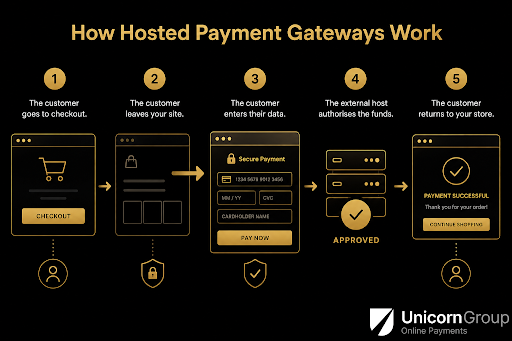
To process these payments smoothly, your website connects directly to a secure, external hosted payment page that contains a hosted payment form. This process follows a simple sequence of steps:
- The customer goes to checkout. When the buyer is ready to pay, they click the checkout button on your e-commerce site.
- The customer leaves your site. The website safely sends the customer to an externally hosted payment page managed by your payment provider.
- The customer enters their data. The buyer fills out their payment details on a secure hosted payment form inside that page. This keeps their sensitive payment information completely off your servers.
- The external host authorises the funds. If there are sufficient funds in the customer’s bank account, the transaction is approved.
- The customer returns to your store. The system redirects the customer back to your website with a confirmation message.
The external host that collects your customers’ data must keep it safe and offer technical support if problems arise.
In Europe, the e-Commerce Directive sets out clear transparency rules for online stores. The Digital Services Act protects buyer rights on digital marketplaces. Because of the ethical, legal, and technical burden associated with online sales, choosing the right host is an important step.
Three Types of Hosted Payment Gateway
There are three primary methods merchants use to process transactions online. The right checkout setup depends on how much control you want over your user experience and data security.
| Gateway Type | Checkout Location | Branding Control | PCI Compliance Responsibility |
| Hosted | Off-site (provider’s page) | Low or sometimes none | Handled entirely by the provider |
| Self-Hosted | On-site (your server) | Full customisation | Handled entirely by you |
| API-Hosted | On-site (via plugin/API) | Full customisation | Shared (requires SSL on your site) |
Each hosted gateway option caters to different business sizes and technical needs. To help you select the right layout for your digital storefront, let’s look at how these three systems function in the real world.
Hosted Payment Gateway
A hosted payment gateway is an external e-commerce tool that handles your checkout process on a separate, secure website. When your buyer clicks on the checkout, your store automatically redirects them to the payment provider’s site to finish their transaction.
The entire payment process happens off-site through a secure channel for credit card data. No sensitive details ever touch your servers. This setup ensures you do not have to worry about complex PCI-DSS compliance rules or managing technical support.
Hosted payment gateway examples include aggregate merchant account service providers like PayPal, Stripe, and Square. It also includes dedicated gateway specialists like Unicorn Group and Opayo (formerly Sage Pay).
Pros of a Hosted Payment Gateway
Hosted payment gateways offer a highly secure payment method with minimal technical setup for merchants. Buyers get a familiar, reputable checkout experience where they use their existing account or their preferred credit or debit cards.
Most providers accept international cards and perform automatic currency conversions. This allows you to sell your products to shoppers around the world.
Cons of a Hosted Payment Gateway
The major drawback to a hosted payment gateway is that it takes customers off-site. This interrupts the purchase process and increases cart abandonment. Your logo and branding may not appear on the external checkout page with some providers. This causes some buyers to lose trust, question whether the checkout page is genuine, and ultimately, abandon their purchase.
This design flaw directly hurts sales. Industry data shows that 19 per cent of shoppers abandon checkouts due to a lack of trust when entering their credit card details.
Large-scale businesses also lose a significant share of their profits to the expensive fees associated with hosted providers. Connecting a dedicated merchant account to an integrated payment gateway delivers much lower per-transaction costs at high volumes. Generally, a hosted payment solution is best for individuals, small businesses, and startups.
Self-Hosted Payment Gateway (Non-Hosted or Integrated)
A self-hosted payment gateway (a.k.a. a non-hosted or integrated payment gateway) is one for which the checkout process lives entirely on the merchant’s website.
Pros of a Self-Hosted Payment Gateway
A major advantage of integrated gateways is that you customise every field and add your own branding to the checkout page. Shoppers complete the entire transaction directly on your site. This drastically improves the customer experience. This seamless journey keeps buyers focused and reduces the likelihood of cart abandonment.
Cons of a Self-Hosted Payment Gateway
The main drawback is that sensitive card data passes directly through your server instead of only the provider’s secure platform. Even if you don’t permanently store the data, handling this data forces you to maintain strict PCI-DSS compliance on your end. You also have to navigate technical issues in-house without an external support team.
API-Hosted Payment Gateway
An application programming interface (API)-hosted payment gateway uses special software code to blend your website’s branding with external security. It allows you to connect a payment processor to an e-commerce platform using ready-to-paste plugins or software modules.
The API gateway structure delivers a best-of-both-worlds approach to payment processing. It gives you full control of branding and customisation while keeping sensitive data off your server.
Providers like Unicorn Group supply these API modules for all major shopping carts. Our team builds custom API modules for new e-commerce platforms on request. By partnering with a merchant account provider, you also secure comprehensive merchant services and dedicated support.
Pros of an API-Hosted Payment Gateway
API-hosted payment gateways offer multiple payment options and enhanced security with customisable fraud protection, chargeback mitigation, and round-the-clock technical support. Merchants can easily set up more complex transaction types such as deferred payments, recurring payments, and loyalty reward points. For customers, API-hosted payment gateways offer a seamless checkout experience that directly increases their trust.
Cons of an API-Hosted Payment Gateway
Accepting payments directly on your checkout page requires a secure socket layer (SSL) certificate and strict security measures to ensure full PCI compliance and prevent data breaches. Merchants who choose an API plugin attached to a dedicated merchant account usually pay an initial setup fee and monthly service fees. However, the long-term per-transaction rates are far lower than the costs of a standard hosted payment gateway.
Choosing the Best Payment Gateway Provider for Your Business
Every business, from a novice blogger to a multinational company, will find a payment gateway that fits its specific needs. The key is to find the gateway provider that matches your business model and scales with you as you grow.
For a new online store that’s not ready to take on the responsibility of PCI compliance, a hosted payment gateway is the simplest way to process payments. Serious businesses that require a professional appearance and advanced payment options get the best results by connecting an API-hosted payment gateway to a dedicated merchant account. Unicorn Group provides all of these options and tailors them directly to your individual business needs.
No matter which method you choose, ensuring secure transactions is one of the most important steps you will take for your e-commerce business. Prioritising data protection builds immediate consumer trust, and your customers will thank you for a safe checkout experience.
Published: May 15, 2022
Last updated: July 28, 2026




A.J. Almeda is a payment processing and merchant services expert with 15 years of experience helping businesses optimise payment solutions, streamline their checkout process, and improve operational efficiency. With a strong background in e-commerce and digital marketing, he brings a wealth of understanding of online retail, omni-channel sales, and customer acquisition to help businesses grow revenue and scale successfully.